4, 16, 20 & 22 High St, Rainham
Rainham
Kent
ME8 7JE
United Kingdom
Map
Sorry, no records were found. Please adjust your search criteria and try again.
Sorry, unable to load the Maps API.
Description
The area around the High Street in Rainham Kent has been settled since prehistoric times, with evidence from the Iron Age, Roman and Saxon periods, and from the medieval period up to the present day.
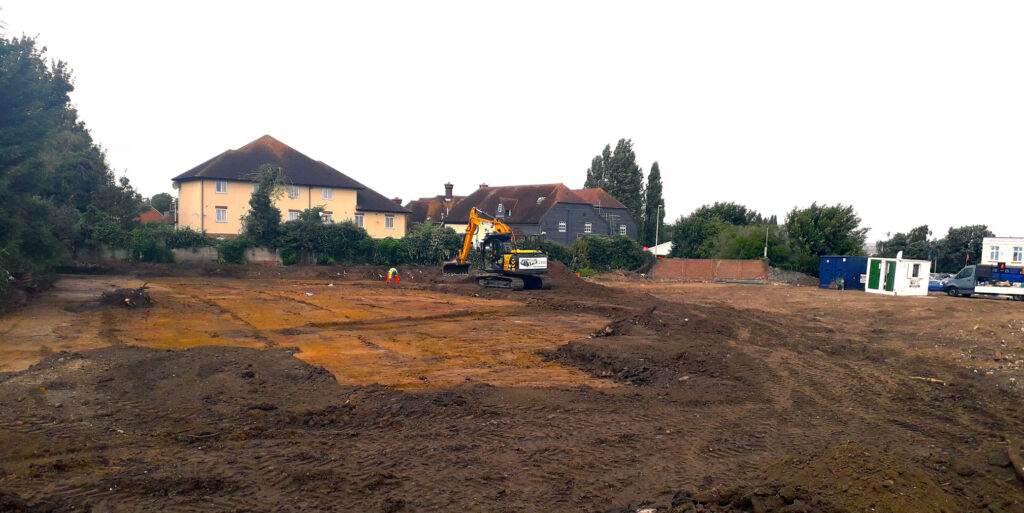
The project, involved the demolition of four residential plots and the construction of a block of 54 retirement living apartments with associated facilities and landscaping. Pre-Construct Archaeology Ltd London were commissioned to undertake archaeological mitigation works in response to a planning condition based on a prior evaluation of the site.
Archaeological works commenced with a watching brief (monitoring and recording) in the north of the site while properties were demolished, with the demolition crew working from west to east. Within the western half of the site several small pits, postholes and a ditch, possibly dating to the early Iron Age and medieval periods were discovered, excavated and recorded. As the watching brief continued to the east, it became apparent that construction of the existing properties had caused very little damage to the archaeological horizon, with the discovery of a multitude of pits, postholes and ditches.
Due to the wealth of the archaeological features discovered in the eastern part of the watching brief area, Medway Council requested that two further trenches be excavated in the south-east corner of the site. The southernmost trench did not expose any archaeological features, whilst the northern trench contained pits and a potential grave, leading to another extension to the area of excavation, now to include the entire site, an area of nearly 0.4ha.
During the course of the excavation features were recorded across the site dating to five different periods, the Iron Age, Roman, Saxon, medieval and post-medieval. However, most of the features recorded during the excavation appeared to date to the Iron Age.
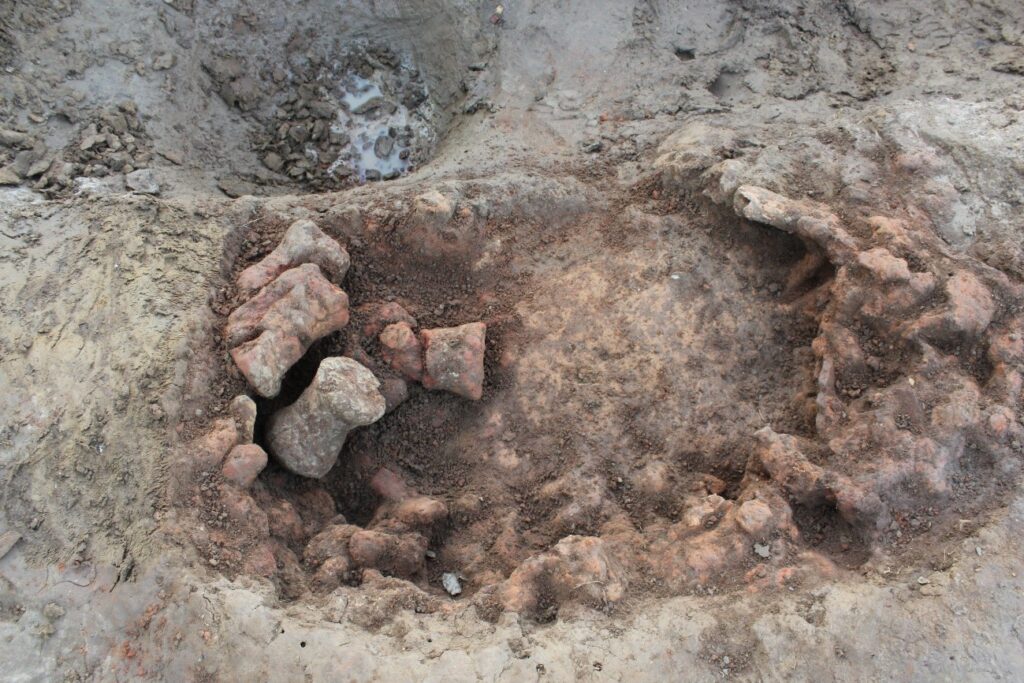
At least two saltern hearths were observed and recorded. These features, probably forming part of the secondary processing of salt in the early Iron Age, are extremely rare and their discovery is at least of regional importance. Three intercutting groups of pits were also recorded, which contained material probably associated with rake-out from the saltern processing.
Samples were taken from the pit groups for radiocarbon dating, which provided dates of 800-400 BC. The pits are indicative of grain storage and possible quarrying of the natural brickearth deposits and are thought to have been re-used for the dumping of domestic and industrial waste at a later date.
The line of the Roman Watling Street lay to the south of the site, and Romano-British features were also found, as were a group of Saxon graves with grave goods, including knives, keys, beads and the remains of a box with iron fittings. Other finds included pottery fragments and Roman coins and hobnails. Medieval and post-medieval ditches and pits attested to the continuing occupation of the site, probably for agriculture.
Public outreach during the excavations included updates on social media, and following recommendations arising from a post-excavation assessment, the site will be published in an academic journal. This may well form the basis for further research given the rarity of the saltern hearth features uncovered, and their significance to understanding the economy of Iron Age Britain.