Dyers’ Hall, City of London
City of London
Greater London
EC4R 2ST
United Kingdom
Map
Sorry, no records were found. Please adjust your search criteria and try again.
Sorry, unable to load the Maps API.
Description
Pre-Construct Archaeology London was offered the rare opportunity to undertake archaeological investigations within one of the London guildhalls, Dyers Hall, where a new lift was to be installed.
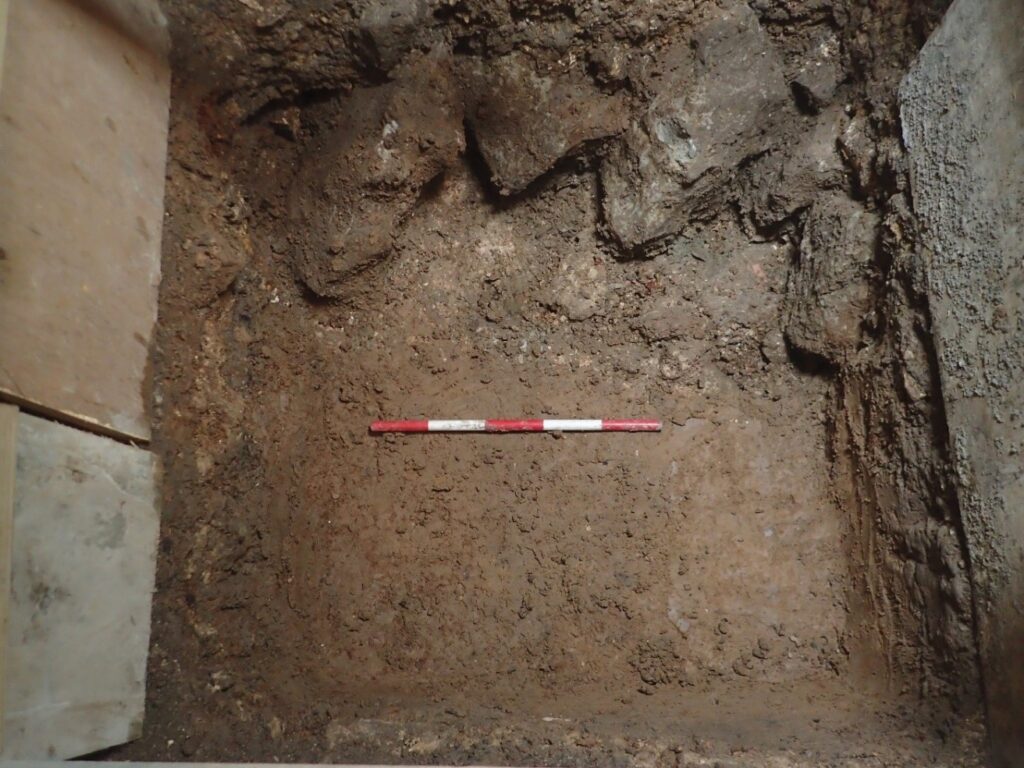
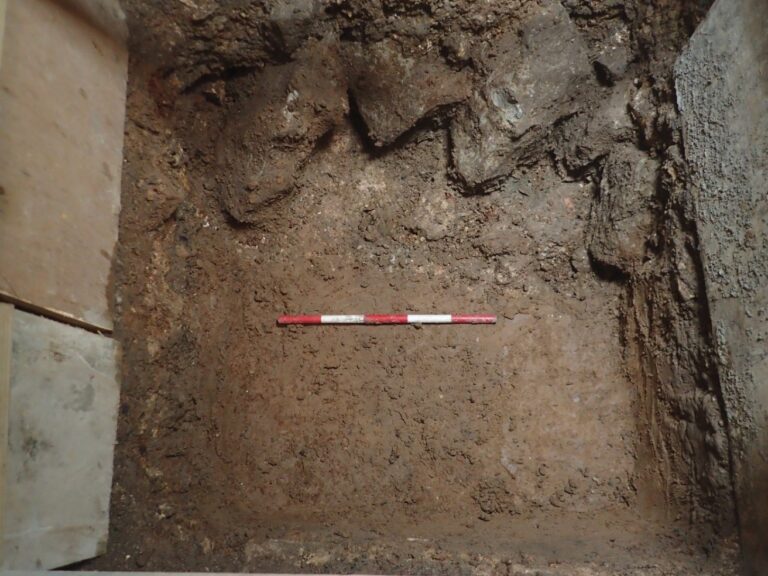
The trench was by necessity small, measuring c. 6m², and was located in the northwestern part of the Hall, within the white wine cellar.
The site is located within City of London Archaeological Priority Area, an area of high archaeological potential and within a Scheduled Monument, the Dyers’ Hall itself. The Scheduled Monument list entry states that a Roman tessellated floor was found on the site, c. 5m below ground level, during 19th century rebuilding of the Hall. Scheduled Monument Consent must always be applied for and given, by the Secretary of State for Culture, Media and Sport before any work on a Scheduled Monument can commence: this can be carried out via the Historic England website Scheduled Monument Consent | Historic England. Along with planning permission, Scheduled Monument Consent was granted by for a package of works to enable the construction of the lift including the excavation of a lift pit.
Six separate underpinning pits were excavated and eventually joined up to create the lift pit. The methodology involved excavating a pit, constructing a reinforced frame and casting the concrete pin, then backfilling the pit before excavating an adjacent one: this meant that the archaeological remains could not be seen altogether at the same time. Instead, they had to be excavated in stages, stitching together the layers as seen within in the confined spaces of the previous pit, quite a challenge for the supervising archaeologist.
Dyers’ Hall is built upon land that was once within the floodplain on the eastern side of the River Walbrook, an important tributary of the Thames prior to and during the Roman period (now confined to a modern sewer). The excavation recorded a sequence of archaeological deposits 2.5m deep, mainly of Roman date, which included the north-east corner of a building, constructed of stone, the remainder of the building being beyond the limits of the excavation.
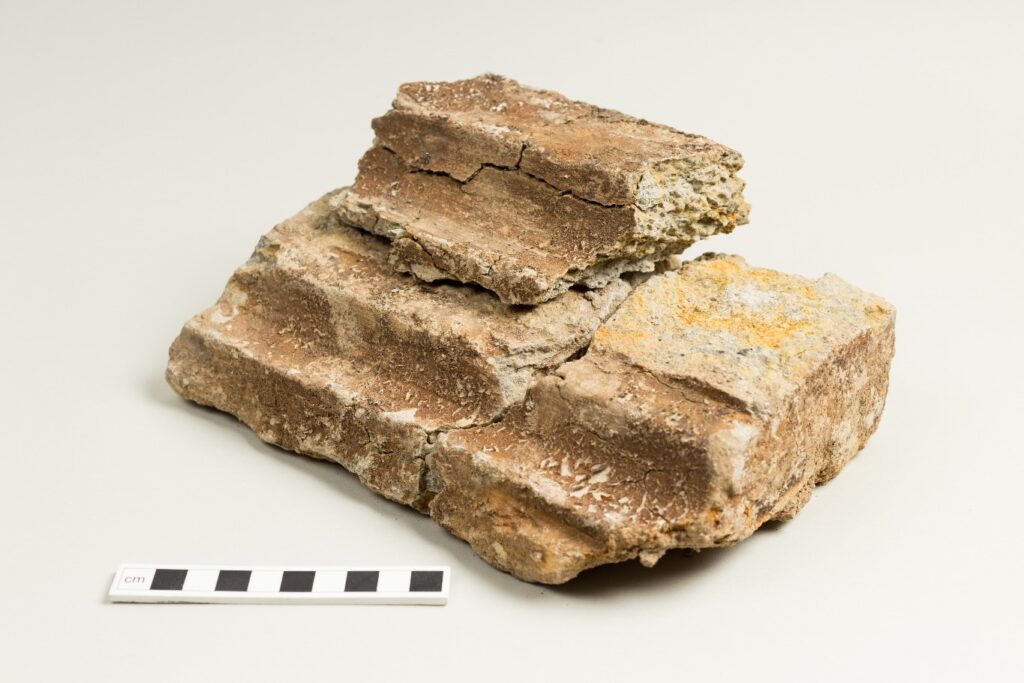
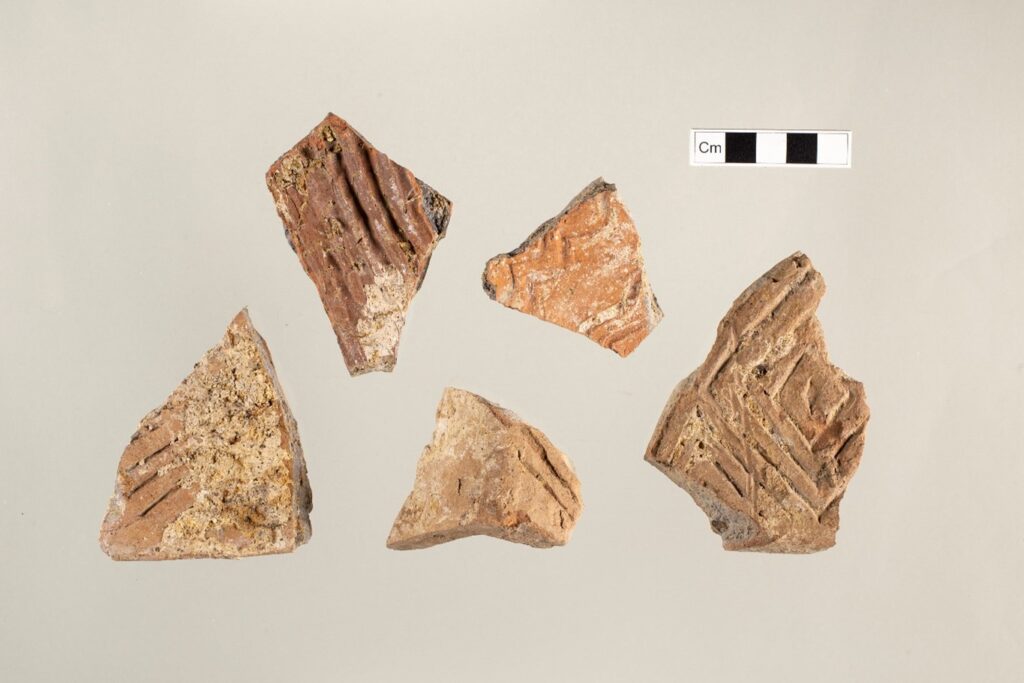
Artefacts recovered included many fragments of painted wall plaster and box flue tiles as well as mosaic tesserae and personal items. Of particular importance was a fragment of a carved cornice of Purbeck marble, painted red on three sides, recovered from one of the earliest deposits recorded within the investigation. This was only the second example of this rock to have been found in London with surviving paint on it and it can be attributed to the 1st century AD. All the finds recovered indicated that an important Roman building may have once lay on the site or close by and it was postulated that they may be evidence for a bath house.
The findings of the investigations were subsequently analysed by PCA specialists and were published in The London Archaeologist Vol.16 No.4 / Spring 2021.