Elephant and Castle Leisure Centre
Southwark
Greater London
SE1 6FG
United Kingdom
Map
Sorry, no records were found. Please adjust your search criteria and try again.
Sorry, unable to load the Maps API.
Description
The Elephant and Castle Leisure Centre, constructed 1979-1980, overlay part of the churchyard of St Mary Newington and is located within an Archaeological Priority Zone as defined by the London Borough of Southwark in the Southwark Plan. St. Mary’s was originally a medieval village church set in the rural landscape to the south of the City of London, it went through upheaval during the Civil War and was later engulfed by the rapid expansion of London in the 19th century to find itself a part of an industrial metropolis.
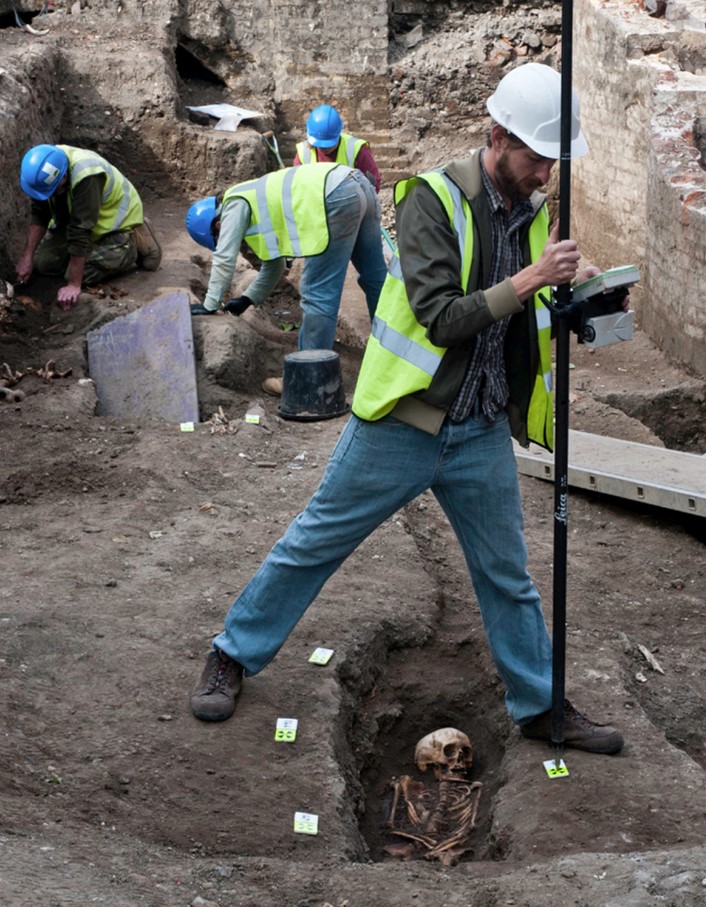
The development project involved the demolition of the Elephant and Castle Leisure Centre and the construction of a high-rise residential block and smaller ancillary buildings. Pre-Construct Archaeology London undertook an archaeological investigation on the site, initially as two trial trenches followed by an open area excavation on land adjacent to what is now St Mary’s Park, historically a part of St Mary Newington churchyard.
Archaeological investigations of burial sites from the modern era are strictly regulated and the fieldwork undertaken by PCA was guided by the regulations of the Disused Burial Ground (Amendment) Act, 1981 and under the terms of a Burial Licence issued by the Ministry of Justice.
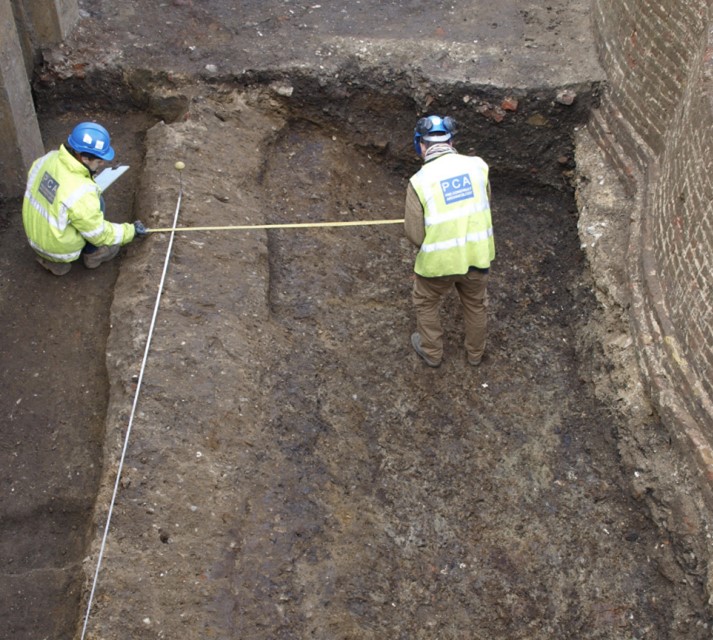
Following demolition, excavation began with machine clearance of overburden that revealing 25 brick burial vaults, the footings of St Gabriel’s Chapel of Ease and a church yard wall. To the east of the church yard wall, the back yards of 19th-century houses were uncovered. This area was recorded, and the subsequent excavation of inhumations originally within the cemetery of St. Mary Newington commenced.
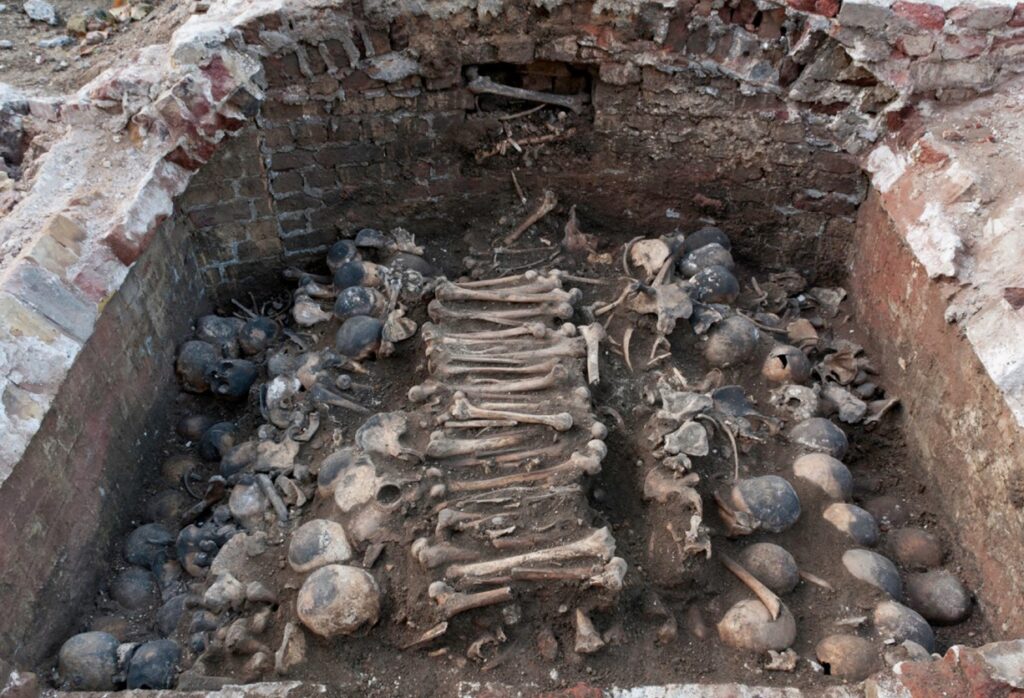
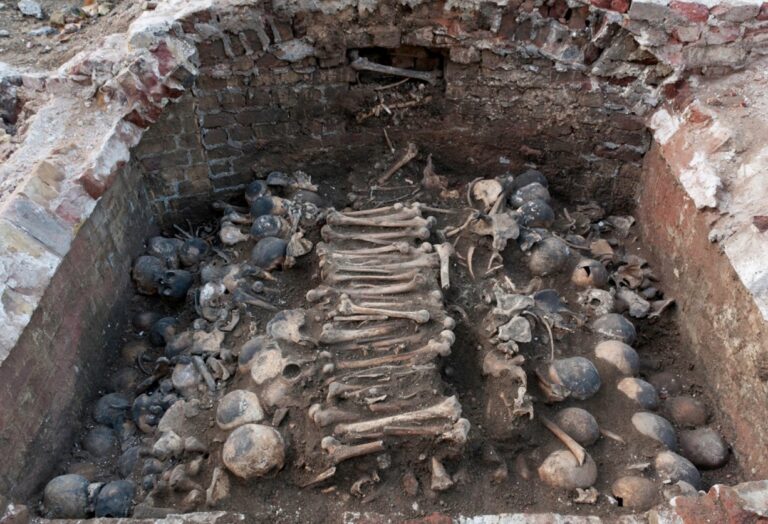
The brick vaults were found to contain both lead coffins and charnel. A specialist exhumation team had been engaged to remove the disarticulated human remains from these vaults. Because of the health risks involved with corroding lead, special care had to be taken with the handling of lead coffins. This was particularly the case where the roofs of the burial vaults were still intact, as demolition here could potentially result in damage.
Six periods were identified on the site: natural geological deposits; 16th-century foundations of the parsonage; a large ditch possibly related to the English Civil War (1643) and the construction of the churchyard wall between 1760 to 1825; expansion of the cemetery and the construction of a series of vaults, 1825 to 1834; the burial cemetery, 1834 to 1854; and closure of the cemetery and subsequent developments, 1854 to the mid-20th century.
The ditch feature exposed in the excavations continued over a length of 24malthough only the southern side was revealed. It is possible that the ditch formed part of the network of defensive ditches and ramparts that defended Parliamentarian London from Royalist troops from the spring of 1643 onwards.
A total of 316 individual articulated human skeletons were uncovered, the majority of which dated from the mid- to late 19th century although three individuals were from the mid-18th to the mid-19th century. Several thousand disarticulated elements of human bone were also exhumed, notably from within the 25 brick vaults.
Following the excavation and analysis of the human remains and finds, a monograph was produced detailing the results and setting the site in the wider context of Newington especially in the mid- to later 19th century.