Iceland Wharf
London
Greater London
E3 2JP
United Kingdom
Map
Sorry, no records were found. Please adjust your search criteria and try again.
Sorry, unable to load the Maps API.
Description
In 2022 Pre-Construct Archaeology London was commissioned to undertake an open area archaeological excavation and watching brief (monitoring and recording) in advance of the development of the site for mixed-use residential purposes. The site was situated on the western bank of the River Lea Navigation occupying an area of 0.51 hectares and had recently been subject to demolition and clearance to slab level.
The site had previously been the subject of numerous studies including site investigations, watching brief and archaeological evaluation works, also undertaken by PCA. The site was located within a rich archaeological landscape, at the location of a known Roman river crossing on the road between London and Colchester, where Roman era masonry had been found in 1909. In the late 19th and 20th centuries the site had undergone heavy industrial usage, resulting in major ground contaminants.
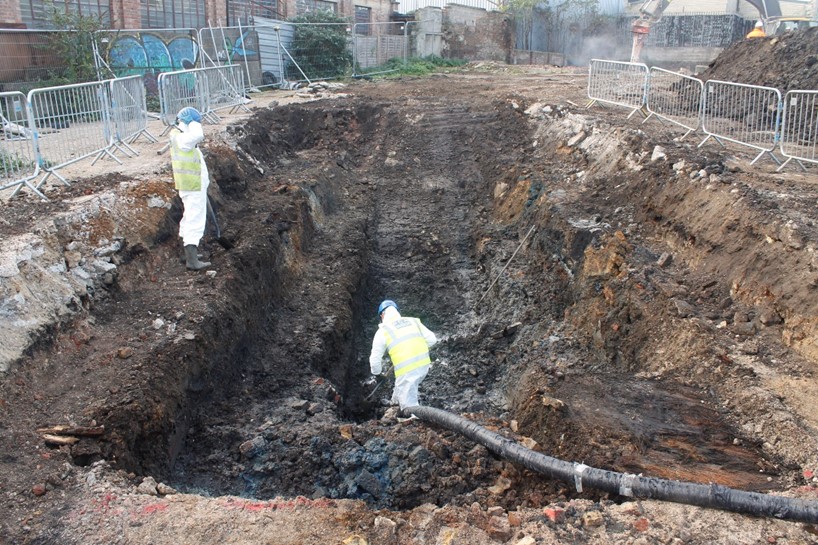
These contaminants were present in the highly variable made ground encountered across the site, ranging in depth from 0.3m depth to 4.5m. The contaminants included spent oxide associated with an Ammonia works as well as bulk asbestos and elevated concentrations of arsenic, lead, copper, zinc, cyanide, sulphide, total PAH (including benzo(a)pyrene and naphthalene), total TPH and organic carbon. The presence of this toxic mix of contaminants posed a hazard to health and dictated the methodology of the archaeological investigations. With advanced planning, PCA was able to draw upon its experience to establish safe ways of working to mitigate any risk to the health of staff whilst working alongside the principal contractor responsible for the ground remediation. The archaeologists were therefore subject to strict PPE requirements consisting of disposable overalls, half masks with A1B1E1K1P3 filters, steel toe capped Wellington boots, inner nitrile gloves, cut resistant outer gloves and eye protection.
The excavation comprised an open area to the west, where ground was less contaminated, and watching brief across the east of the site, where archaeological features and deposits across the lower lying eastern area of the site were heavily contaminated. Due to the health and safety constraints, remote recording of archaeological features and deposits using digital means was undertaken where possible. This included surveying with a Geomax GPS system, photography, use of a Dictaphone and context sheets being written up in a clean area. Where archaeologists were able to use hand tools, filling in context sheets and planning of features took place on site, and hand planning was used in areas where the Geomax was unable to receive signal. Finds and environmental samples were collected and retained for specialist analysis only from areas that were deemed to be safe for hand excavation.
The earliest archaeological features recorded dated to the late Roman period and comprised a series of ditches, postholes and large quarry pits. No further evidence of occupation was observed until the late medieval period when ditches and a pit were recorded across the higher ground to the west of the site.
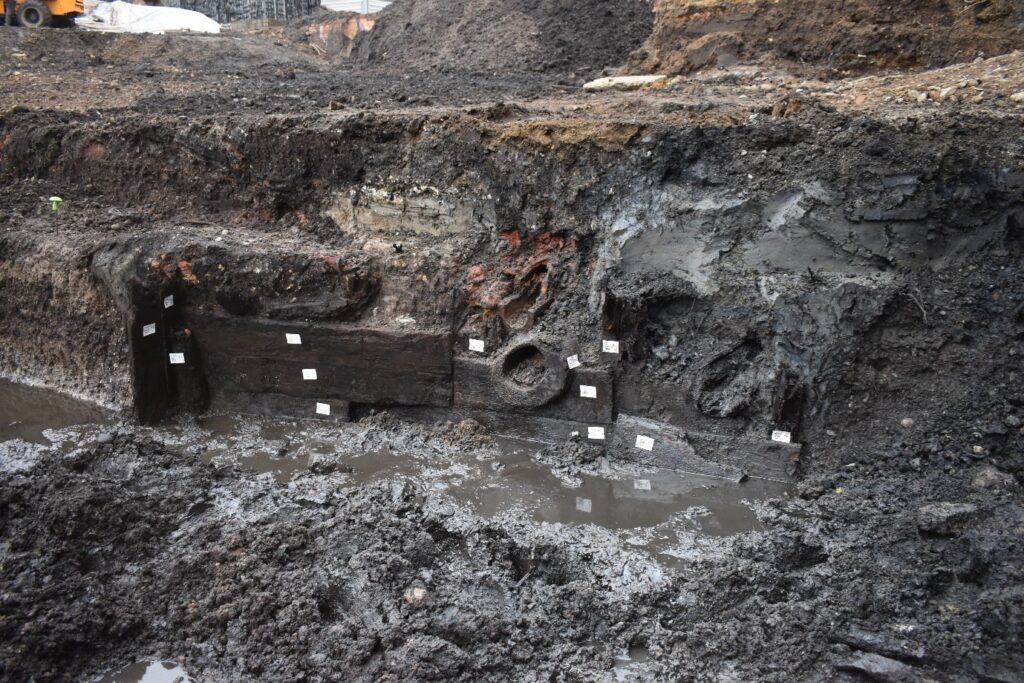
A more intense occupation of the site in the late 17th−early 18th century was demonstrated by a large number of rubbish pits. By the mid- 18th−19th century the River Lea had been canalised and a series of revetments, drainage and ground raising had taken place across the east of the site. The first phase of industrial building also took place during this time, which survived in the form of brick and timber foundations, likely representing a ‘Chemical Works’. Domestic dwellings were also constructed at this time. Redevelopment of the site took place in the 19th century, and activity on the site continued throughout the 20th century until the present day.
An assessment report was written at the end of the excavation which also included findings from the earlier watching brief and evaluation phases which were previously reported separately.