Inkershall Grange Farm, Bilsthorpe
Newark
Nottinghamshire
NG22 8TN
United Kingdom
Map
Sorry, no records were found. Please adjust your search criteria and try again.
Sorry, unable to load the Maps API.
Description
Inkershall Grange Farm is located within the historic medieval Sherwood Forest. A Desk Based assessment determined, that there was potential for features of medieval date and the land was, in the post-medieval era, a defined farm.
Pre-Construct Archaeology Ltd Newark was commissioned to undertake an archaeological evaluation comprising 221 machine-dug trenches. For the most part, these determined a low level of archaeology across the landscape, but included eight ditches were interpreted as possible field boundaries in a post-medieval agricultural landscape. Several natural features representing tree hollows/throws and rooting were also recorded across the site and probably reflect the earlier forestation of this area. Newark and Sherwood Council subsequently required Strip, Map and Record investigation of three small areas. The site covers an area of c. 79 hectares; an area covering c. 1 hectare was excavated during the strip, map and sample investigation.
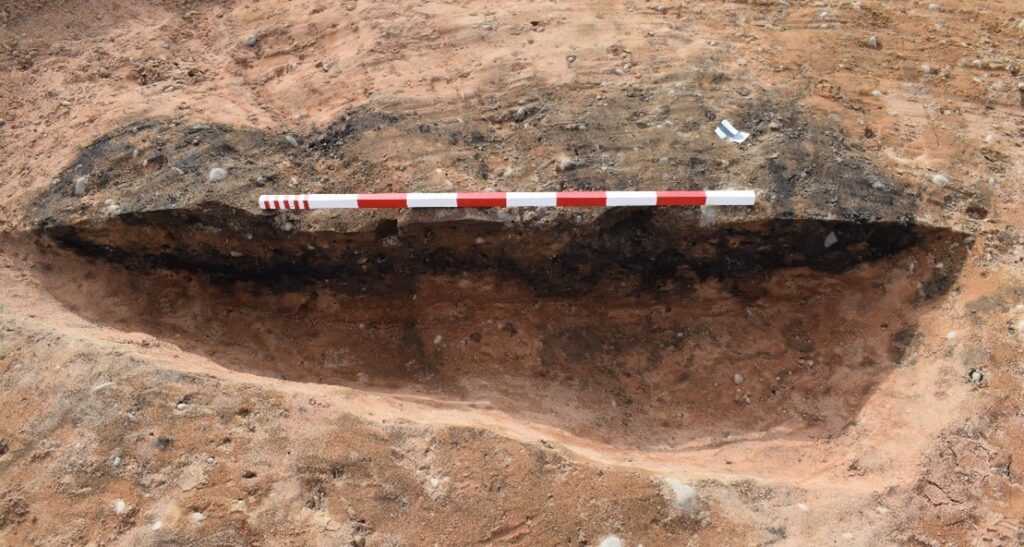
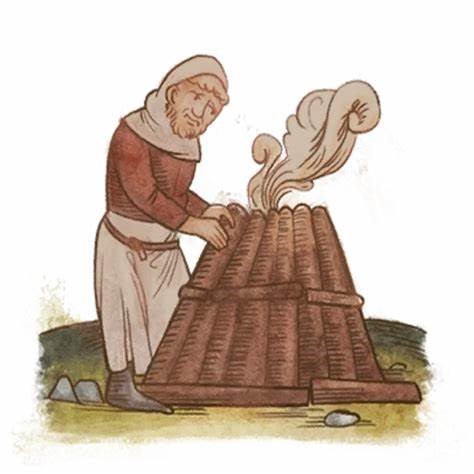
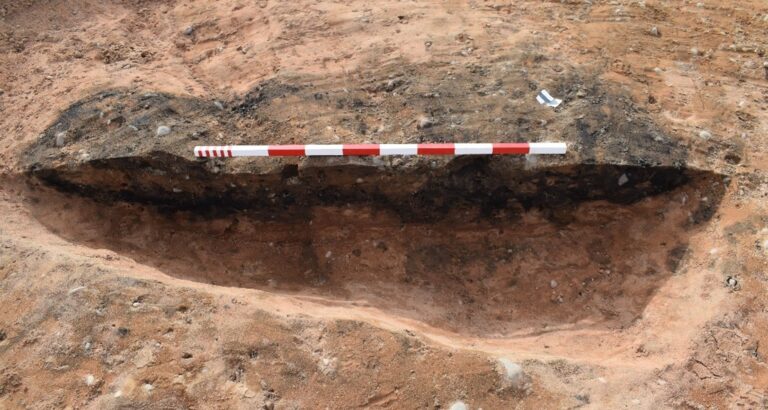
During the evaluation phase, eight oval pits containing high quantities of charcoal of varying sizes had been identified: these are thought to have been the remnants of medieval ‘charking’ pits used to produce charcoal for a number of medieval industries including metal working. Radiocarbon dates from one of these indicated a Saxon or Anglo-Norman date for production.
The three areas excavated during the SMR stage of work revealing a further ten pits, most with charcoal-rich fills. Two of the pits were radiocarbon dated to the mid- to late Saxon period, and a further pit by ceramic dating to the 13th – 14th century demonstrating that charcoal was produced at the site for about 600 years.
The charcoal in the pits derived exclusively from oak wood which was presumably sourced from the adjacent forest.
Charcoal was a very important resource in Medieval England, used in a myriad of industries from cloth dying, glass and pottery making to metal production and working. Forest trees were initially coppiced and managed to encourage a continuous supply of wood for the charcoal, but such was the growth of towns and England’s economy that demand soon outstripped this sustainability and by the 1600s there was a national timber shortage.
The results of the investigation add to the body of evidence for charcoal production or storage in the area during the Saxon and medieval periods, but no further publication or dissemination were required as art of the planning process.