Land at Manor Farm, Stoke Orchard
Stoke Orchard
Gloucestershire
GL52 7RY
United Kingdom
Map
Sorry, no records were found. Please adjust your search criteria and try again.
Sorry, unable to load the Maps API.
Description
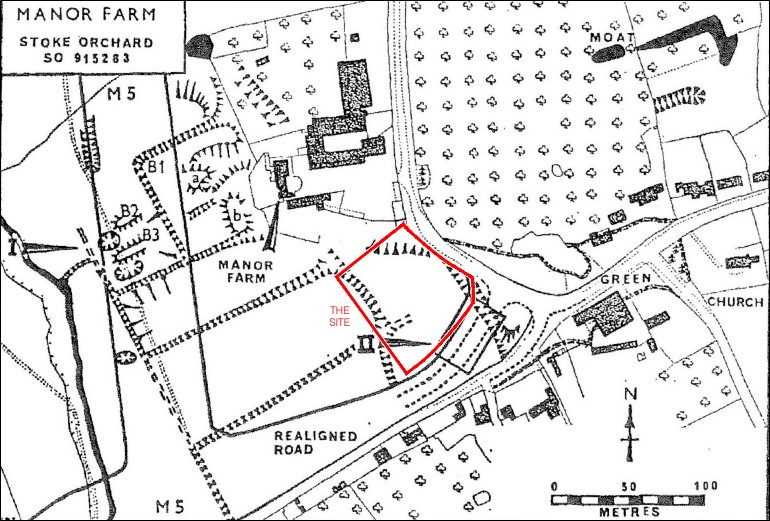
PCA Warwick was commissioned to undertake a programme of archaeological investigations on land at Manor Farm, ahead of a housing development comprising nine residences, garages, roads, and services, which has been approved by Tewkesbury Borough Council. The investigations were required following a Desk-Based Assessment, geophysical survey and evaluation by trial trenching which identified medieval archaeological remains beneath modern overburden associated with the construction of the M5.
Previous archaeological works across the development area identified an organised medieval rural landscape immediately south of a moated medieval manor house, including medieval ditches, gullies, and pits. These were particularly concentrated in the southeast quadrant of the site, where features demonstrated a clear correlation and continuation of medieval features previously identified by survey and excavation carried out in 1969 during the construction of the M5 motorway. The quantities of medieval building daub and domestic pottery recovered at every stage of fieldwork suggested medieval settlement on or close to the development area.
PCA’s evaluation demonstrated that the geophysical survey had not been fully effective due to the depth of made ground and a buried, undisturbed subsoil, which directly overlay the archaeological horizon at a depth of 1m. The depth of the overburden enabled PCA to design a mitigation strategy that could satisfy both the planning conditions and our client. This approach was possible with a redesign of the foundations of some of the structures, for which a technical details application was approved by Tewkesbury Borough Council. It was calculated that, based on the amended construction depths, groundworks would not impact to archaeological levels across the majority of the site and PCA’s monitoring and recording confirmed this. In advance of the groundworks, archaeological excavations were directed to four areas where the overburden had been recorded as shallower than the average. This benefited the client in terms of timescales and expenditure by ensuring archaeological preservation by record in part of the site and in situ across the remainder.
Whilst the post-excavation works are still on-going it is possible to draw together some strands of previous investigations including ditches and three fragments of walls. Finds were domestic in nature but reflected a lower social status that artefacts found in the vicinity of the manor house. The finds analysis at PCA’s evaluation allows for refining the dating in this area and noted residual Anglo-Saxon domestic pottery types dating from the 8th to 10th century. This small assemblage will have a disproportionately large impact on our understanding of pottery production in this period and has been flagged as an important research asset. Overall, it is anticipated that the site will contribute to key research questions for the Early Medieval period including the establishment and development of the ‘English’ shire, the parish and the rural landscape.