Land north of Hethersett
Hethersett
Norfolk
NR9 3SN
United Kingdom
Map
Sorry, no records were found. Please adjust your search criteria and try again.
Sorry, unable to load the Maps API.
Description
PCA Norwich conducted four phases of archaeological fieldwork across the 15ha site, comprising excavation, watching brief, and historic building recording in an area north of Hethersett, located six miles south-west of Norwich. Prior to the construction of a largescale residential development, PCA were commissioned to undertake phased groundworks, to enable the construction of access roads and to study areas designated for construction. Initial works were conducted on the site by another archaeological contractor, comprising a Desk-Based Assessment, geophysical surveys, and an initial programme of archaeological trial trenching, prior to PCA being commissioned to conduct the larger scale excavations and further geophysical surveys.
Previous archaeological investigations failed find evidence for a suspected Saxon cemetery, and the initial PCA trial trenching at the location of the access road failed to locate any archaeological remains. However, within the residential development area itself medieval remains including field boundaries and brick structures were uncovered. The geophysical survey for the larger, later phases did not reveal many anomalies that were not aligned with historic and modern agricultural features, although a Historic Environment Record (HER) search revealed some evidence for prehistoric, Roman, Anglo-Saxon, medieval, post-medieval and modern activity within the site and in the surrounding area.
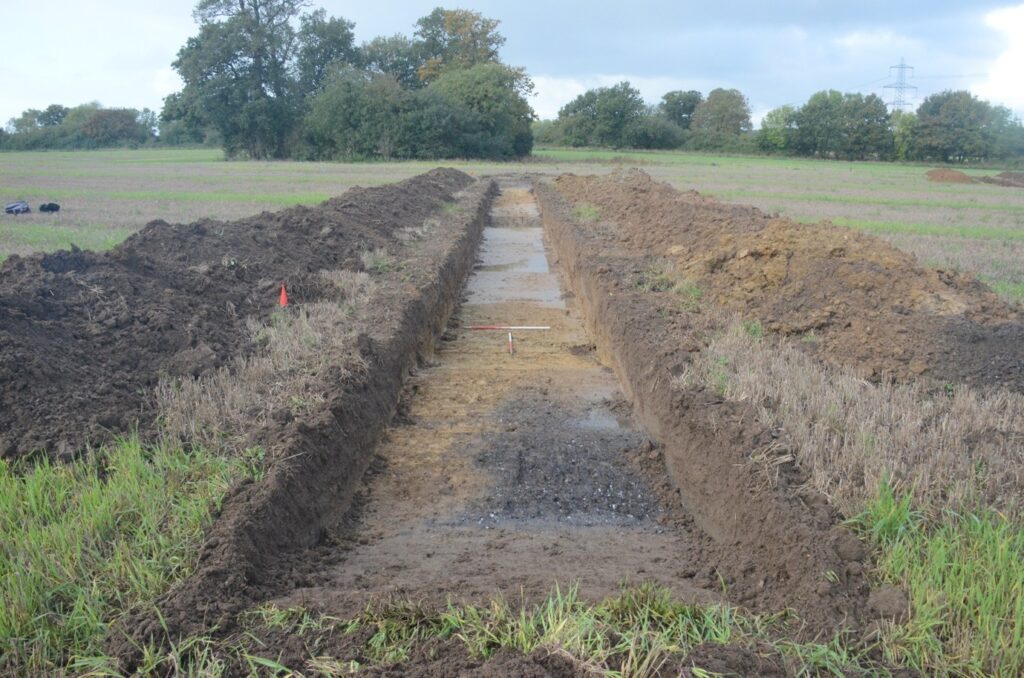
While wet weather encountered during the project posed a challenge to the excavations, this did allow for a clear understanding of how ground conditions within site which may have affected past human activity and explain the distribution of archaeological features. Most notably, the northern and western part of site, where there was most evidence for settlement activity, drained well and remained relatively dry, in contrast the middle of the field held ground water and filled quickly.
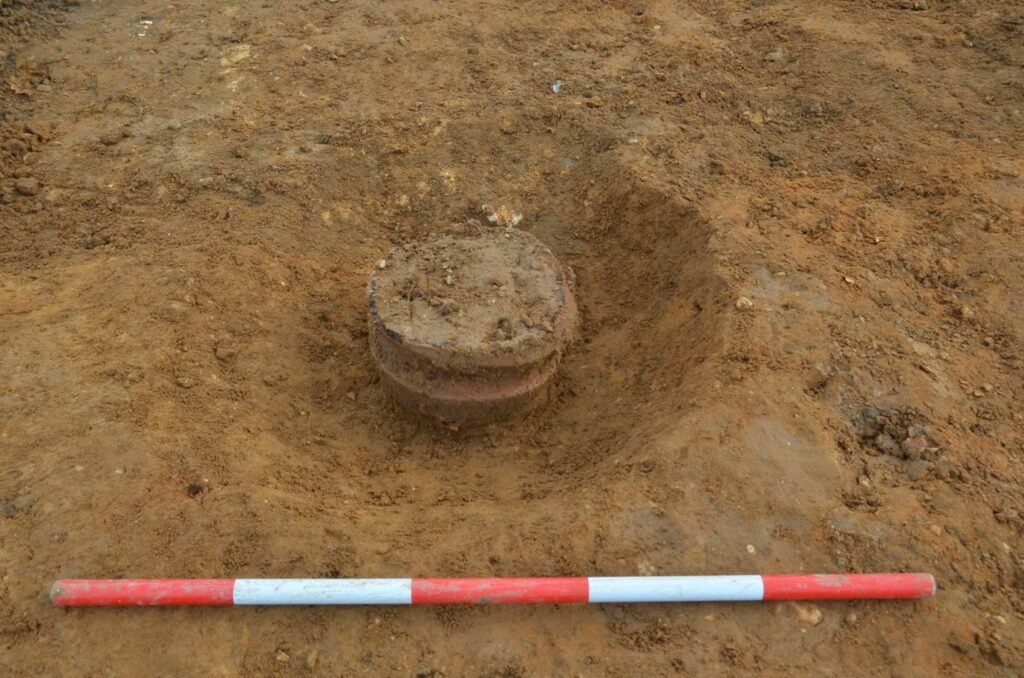
Numerous features of archaeological significance not readily apparent on the geophysical survey were uncovered during the excavation, indicating the importance of excavation to support and test findings of non-intrusive works. These included a prehistoric burnt flint pit, probably deriving from a burnt mound, an assemblage of cremated human bone fragments in a a Mid-Late Iron Age pit, an urned cremation dating to the Late Neolithic-Early Bronze Age containing the remains of an adult and a possible child, evidence for rare and prestigious glass faience beads in an inverted Collared Urn, and a concentration of Roman activity in the west, relating to the suspected villa outside the boundaries of site, proving that the settlement extended further east than initially determined.
PCA was responsible for presenting these archaeological findings in a report, linking discoveries to the previous works carried out on this site and the area immediately surrounding the development area. The significant prehistoric features and finds collected within a primarily agricultural area suggests a special meaning and holds potential to contribute to key research objectives focused on burial and funerary practices from the Neolithic to the Iron Age.