Magdalen College, Oxford
Oxford
Oxfordshire
OX1 4AU
United Kingdom
Map
Sorry, no records were found. Please adjust your search criteria and try again.
Sorry, unable to load the Maps API.
Description
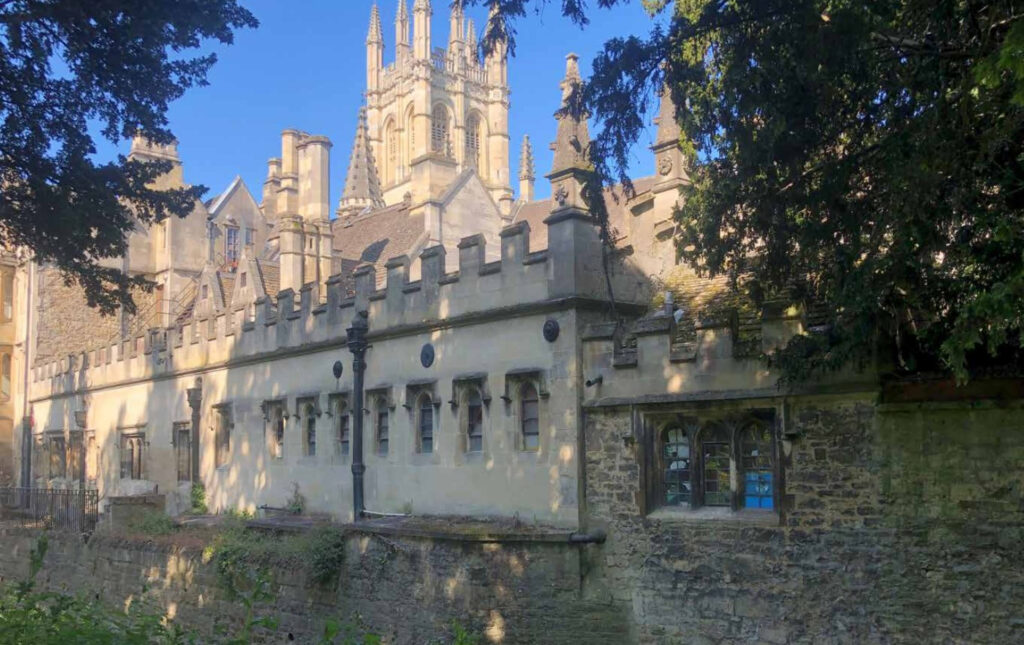
Magdalen College is one of the oldest, largest, and most beautiful colleges forming part of Oxford University. Since 2023 PCA Warwick has been working closely with our clients to progress a challenging project along the riverside in Oxford, including significant landscaping, the construction of a new Garden Room, new student accommodation and the establishment of ground source heat pumps across the college.
The site has a fascinating history and associated listings – there are eight Grade I, five Grade II* and eleven Grade II buildings within the grounds of the college alone, and Magdalen College lies within a Grade I Park and Garden, a Conservation Area and Archaeological Area. In addition, the grounds of the college include the Magdalen Grove sediments, a Site of Special Scientific Interest (SSSI) containing abundant remains of ancient Woolly Mammoth, Brown Bear, Aurochs and Lion.
By the 12th century the area of the college was an eastern suburb of Oxford, likely to have been occupied by burgage plots and ridge and furrow. In 1177 part of this area, from the corner of Longwall Street and the High Street (the later location of Magdalen College) was acquired as a Jewish burial ground, subsequently made available for the re-founding of the Hospital of St. John the Baptist by King Henry III in 1231. The hospital site was awarded to William Waynflete in 1458 for the establishment of Magdalen College. Whilst most of the extant college buildings are of later medieval or 18th–19th century date, the building now known as the Old Kitchen Bar, where the new Garden Room is to be located, is believed to have formed part of the riverside range of the 13th century Hospital of St. John the Baptist. The college also had role in the defence of Oxford in the Civil War period, with the city’s fortifications extending through, or close to, the area of development.
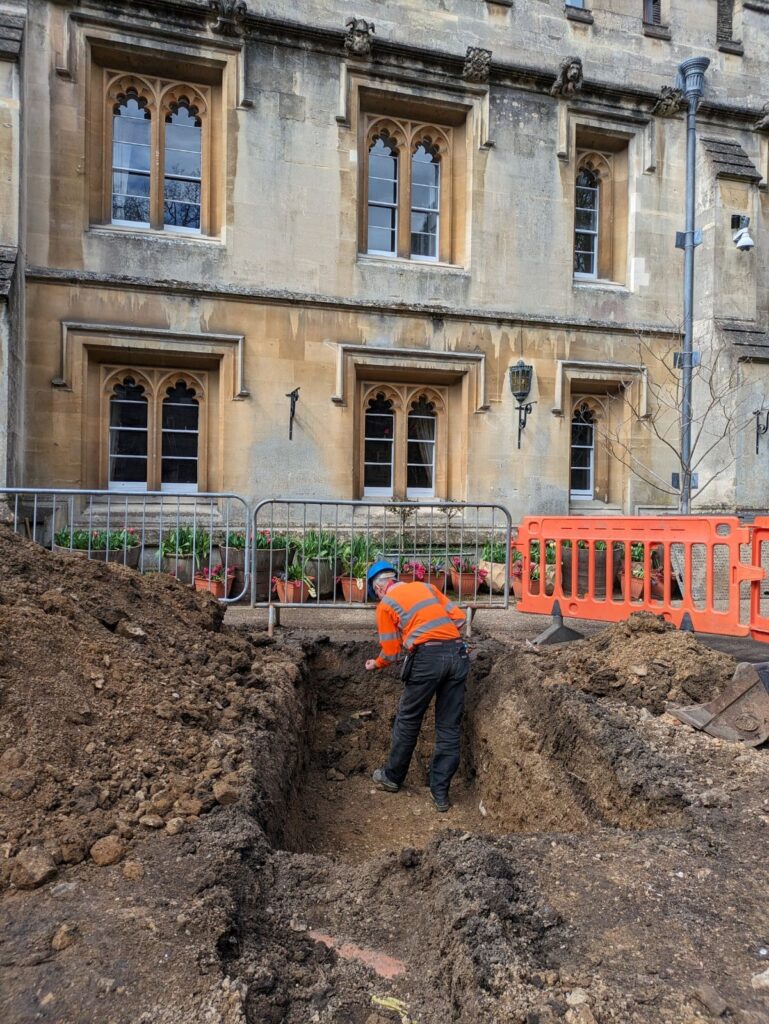
The full range of PCA’s expertise has been called upon as the project has developed. After initial desk-based assessment work, the built heritage team recorded initial phases of opening up works within the college buildings, and two phases of archaeological investigation have been undertaken to date. PCA has developed an extensive deposit model across the wider grounds of the college on the peripheries of the Magdalen Grove fossiliferous deposits where ground source heat pumps are proposed.
Findings include the remains of walls of the medieval Hospital of St John the Baptist, as well as evidence of associated floor surfaces and demolition deposits containing high-status material including an interesting and varied assemblage of medieval plain glazed and decorated floor tiles, used particularly in ecclesiastical buildings across the Oxford region.
The information we have thus far recorded is not only adding extensively to our knowledge of the medieval development along the riverside in this part of Oxford, and of Magdalen College itself, but also informing the design team on the most appropriate construction methods of incorporating and/or avoiding these remarkable remains. With the main phases of mitigation still to come, PCAs work at Magdalen College promises to contribute a fascinating new chapter to the history of the city.