Nun’s Walk
Great Yeldham
Essex
CO9 4PU
United Kingdom
Map
Sorry, no records were found. Please adjust your search criteria and try again.
Sorry, unable to load the Maps API.
Description
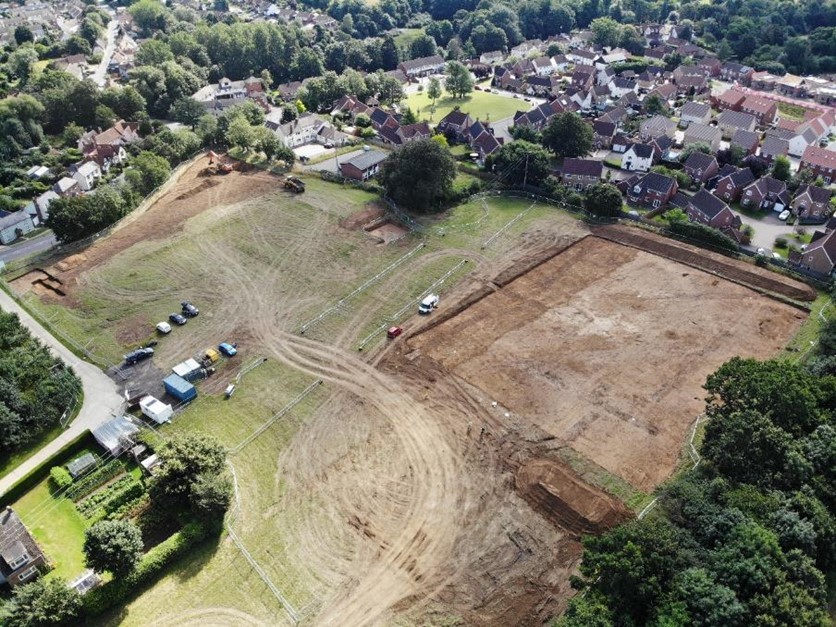
Archaeological excavations were conducted by PCA Cambridge on land at Nun’s Walk to enable a condition, attached to the planning consent, to be completed through extensive and complex archaeological mitigation, prior to the development of the site for residential purposes. These works consisted of the excavation of three areas, covering a total area of 0.39ha, located within an irregular-shaped arable field at the western edge of Great Yeldham, a village that lies approximately 9km to the north-west of Halstead, Essex.
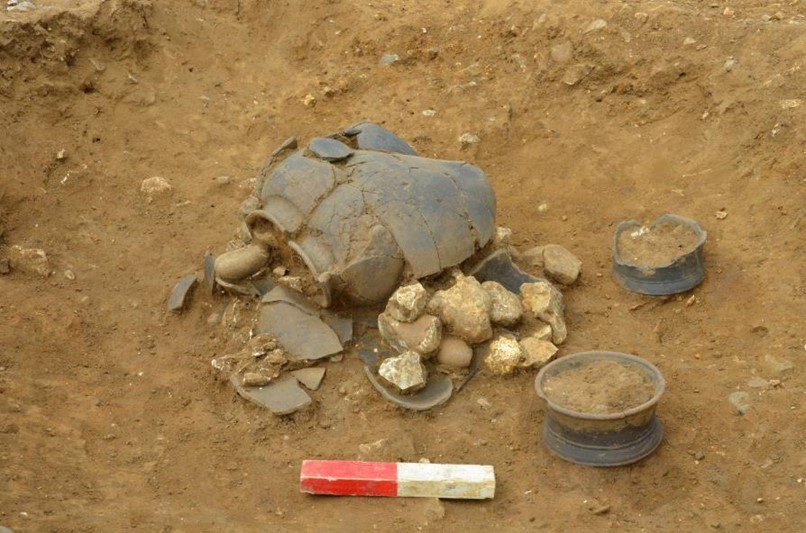
Following an initial stage of archaeological investigation comprising 20 evaluation trial trenches three larger areas were excavated to investigate previously identified archaeological remains. One area, in the north-eastern corner of the site targeted a possible quarry pit, a second, in the centre of site, targeted a series of Early Neolithic pits, with in situ flint working waste and a number of flint tools and the third, located in the south-western corner of the site revealed a small Late Iron Age cremation cemetery, containing ten cremation graves, many accompanied by pottery grave goods dated to the late 1st century BC to the early 1st century AD. A ditch immediately to the north of the cremations formed a likely boundary to the cemetery. Roman rectilinear agricultural ditch systems were replaced by later Roman period clay and gravel extraction activities, as well as Early/Middle Saxon settlement, evidence of which consisted of a possible sunken featured building that contained evidence for bone and antler working, reflecting a continued use of the landscape over an extended period of time.
A post-excavation assessment was produced and is to be followed by a publication in The Essex Society for Archaeology and History Journal, entitled ‘A Mesolithic/Early Neolithic flint-working scatter and a Late Iron Age cremation cemetery at Nun’s Walk, Great Yeldham’. The results from the excavation off Nun’s Walk are of local and regional significance; notably the Mesolithic/Early Neolithic flint-working scatter and the Late Iron Age cremation cemetery and have the potential to contribute to our understanding of early prehistoric activity and Late Iron Age funerary practices in Essex during these periods.