Rochester Airport
Chatham
Medway
ME5 9SD
United Kingdom
Map
Sorry, no records were found. Please adjust your search criteria and try again.
Sorry, unable to load the Maps API.
Description
Pre-Construct Archaeology London undertook simultaneous Historic Building Recording and archaeological evaluation, followed by open area excavation, to facilitate several new structures at Rochester Airport: two hangars for the airport itself, a new hangar for the Medway Aircraft Preservation Society (MAPS), installation of a new fuel-tank enclosure, helicopter pads, creation of a memorial garden and the formation of new car parking as well as access routes. The site was located at the southern end of Rochester Airfield where there was already a number of existing hangars and office buildings, areas of hardstanding, access roads and grassed areas for aircraft parking.
The Historic Building Recording was completed prior to the proposed redevelopment of the site under permitted development rights, which in part entailed the retention and reuse of the larger, historic Hangar 3 and the removal of Hangar 4. The aim of the recording was to better understand these buildings and compile a lasting record of them.
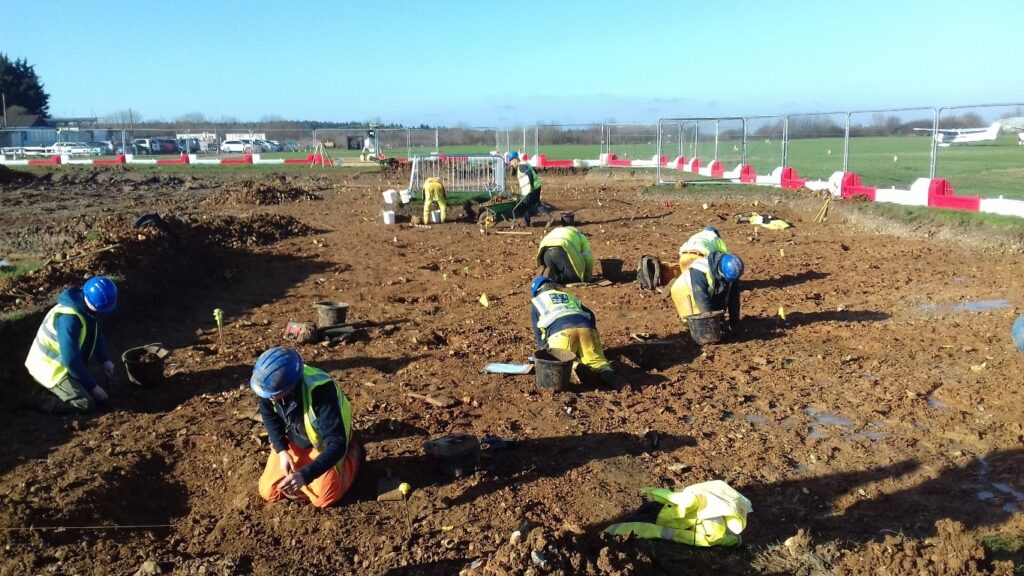
The evaluation had revealed early to middle Iron Age and Roman archaeological remains. Following inspection of the site during those works and presentation of an evaluation report, Kent County Council requested further investigation to mitigate impact of the proposed development on the site. PCA prepared a Written Scheme of Investigation (WSI) for this further investigation, and subsequently, an area approximately 7,063msq was split into five areas of investigation, four of which were subject to ‘strip, map & sample’ and the fifth was covered as a watching brief.
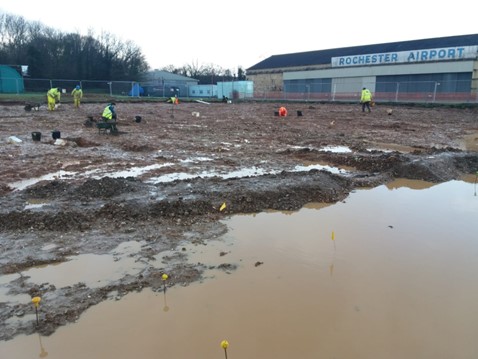
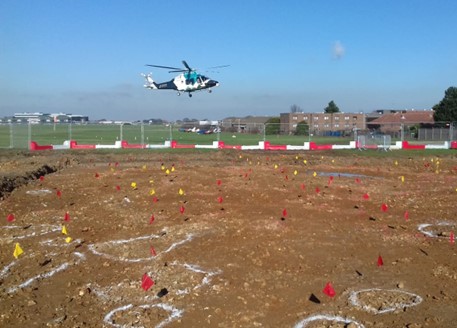
The excavation was challenging due to some very wet weather over the winter months making conditions on the clay site less than ideal for fieldwork. Operating in close proximity to aircraft also required regular scaping and sweeping of the access road dividing the area, and strict control of tools and materials to limit the possibility of foreign objects being introduced into rotors and engines.
At the conclusion of the field work an Archaeological Assessment Report was written which demonstrated that, as activity at the site commenced in the middle to late Iron Age, and extended into the early Romano-British period. The Iron Age features included pits, ditches and postholes, some of which probably formed round-houses and a robbed-out wall of a probable early Romano-British precinct, with associated pits were also recorded. The report concluded that the results of the excavation warranted being published in a peer reviewed journal such as Archaeologia Cantiana, although this has not yet been commissioned.