Sherbourne Solar Farm
Sherbourne
Warwickshire
CV35 8AB
United Kingdom
Map
Sorry, no records were found. Please adjust your search criteria and try again.
Sorry, unable to load the Maps API.
Description
PCA Warwick was commissioned to undertake archaeological investigations to inform on the potential archaeological resource, and the likely impact upon them, ahead of the proposed construction of a solar farm and associated infrastructure and access for which a planning application was granted by Warwick District Council.
The site comprises two plots of land separated by the Sherbourne Brook, a tributary of the Warwickshire Avon, covering a total area of 29.9-hectares. The presence of a number of prehistoric features including pits of Middle Bronze Age date, a D-shaped Iron Age enclosure, and a Late Iron Age to Romano-British trackway, were identified in 2008 and 2009 at the north-end of the site, with the enclosure and a number of potential round houses being, at that time, preserved in situ.
Accordingly, Warwickshire County Council’s Planning Archaeologist stipulated that the site be evaluated in order to ‘ground truth’ the results of three sets of geophysical surveys, all of which were negatively affected by construction materials from the M40 junction. Excluding services and the known archaeology, which would remain undisturbed, 22.52 hectares were to be investigated with 86 trenches measuring 50m long by 1.8m wide.
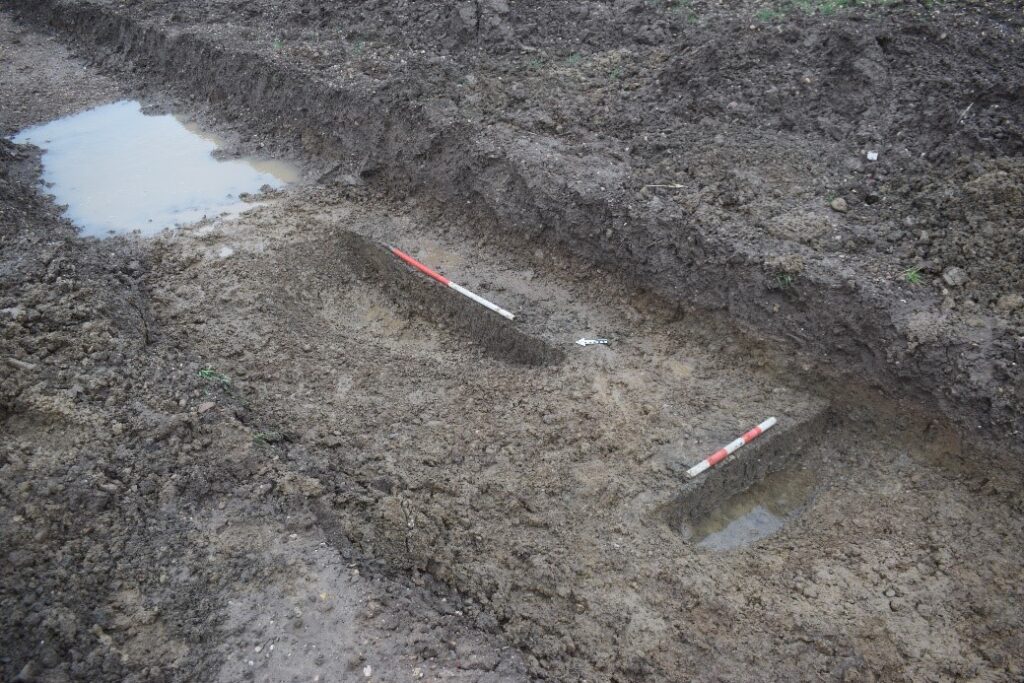
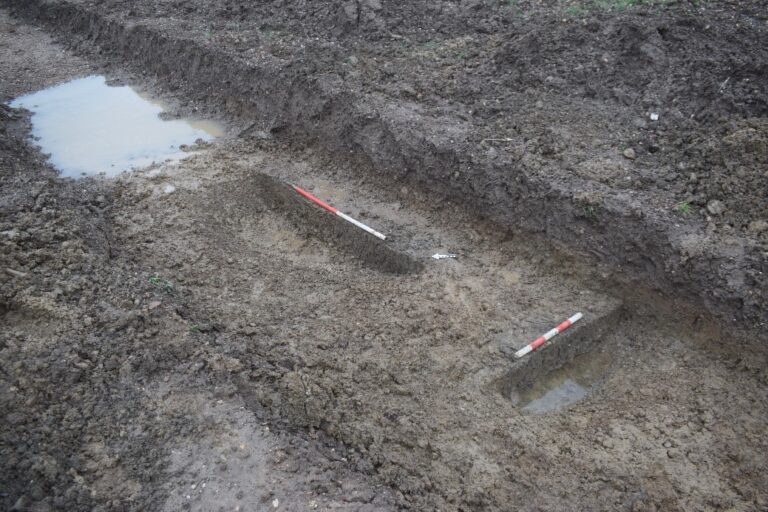
PCA Warwick’s work revealed a landscape that had been heavily ploughed over recent centuries which had horizontally truncated all but the deepest of the features; even the traces of medieval agricultural ridge and furrow had been obliterated by the later agricultural regime. The earliest archaeological activity was a single flint blade, interpreted as being an unfinished and unabraded flint knife of the Early Neolithic period recovered from a ditch fill. Several shallow linear and pits of probable Iron Age date were recorded although the site was finds-poor, and a number of these features remained undated. Given the limited survival of archaeological remains no further archaeological investigations were required and a short report was generated to satisfy planning conditions.