St Andrew’s Church, Congham
Cobham
Surrey
KT11 3EJ
United Kingdom
Map
Sorry, no records were found. Please adjust your search criteria and try again.
Sorry, unable to load the Maps API.
Description
Following an archaeological brief issued by Norfolk Historic Environment Service Pre-Construct Archaeology Ltd Newark was commissioned to undertake a programme of archaeological monitoring during the excavation of a service trench for the installation of external lighting.
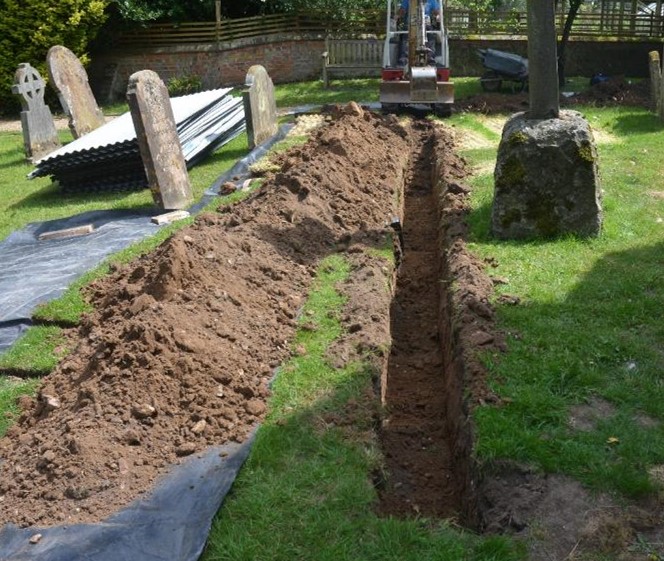
The groundworks involved the excavation of 70 linear metres of service trench to a depth of 0.45m and width of 0.50m to the south and east side of the church. The monitoring was carried out in accordance with a Written Scheme of Investigation and the Requirements for Developer-Led Archaeological Work in Norfolk.
The aim of the work was to record any archaeological features or deposits present in the excavated service trenches. A report was produced describing the results of the monitoring and the completed archive was deposited with Norfolk Museums Service.
Of the three medieval parish churches in Congham, only St Andrew’s survives: the others were abandoned around the mid- 16th century. St. Andrew’s was probably founded during the 13th century and retains several medieval architectural features as well as rare internal woodwork from the 17th century. St. Andrew’s was refurbished in 1873 and is now a Grade II* listed building.
Archaeological evidence was known from around the church including prehistoric flints, Roman tiles and pottery of early through to post- medieval dates including pottery wasters of Saxo-Norman date attesting to production in the vicinity.
The trench was excavated by a 1.5 ton mini- excavator under constant archaeological supervision.
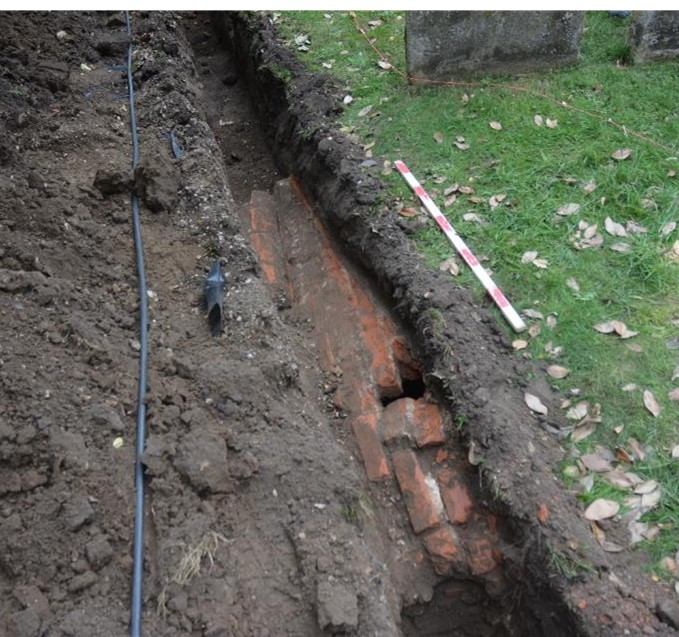
Below a layer of turf was one of made ground that contained a number of disarticulated human bones, representative of at least four individuals that were probably redeposited when the churchyard was landscaped in 1873.These were collected, recorded and given back to the church for reburial. Any undisturbed burial horizon is likely to have been below the lowest level of the service trench. No archaeological features were observed although a late 18th – 19th century brick vaulted tomb was observed and was preserved in situ.